Do dogs need carbohydrate after hard work?
Many people consider raw food without carbohydrate the best diet for sporting dogs. The dog is a carnivore, they say, and does not need starch. I have more than 40 years of experience with working dogs and wanted to know how much of that is proven. Here is the short version.
The question
A dog that attacks, sprints and jumps in protection work needs, among other things, glycogen, the sugar store in the muscle. Is a diet with no carbohydrate at all enough to refill that store?
What sled dogs show
In 1977 the nutrition researcher David Kronfeld fed racing sled dogs a diet without carbohydrate for 28 weeks. In his measurements he found no disadvantages. The dog produces the glucose it needs itself. So sled dogs can work hard without carbohydrate in their food. But they run endurance, not short sprints.
The one proven finding
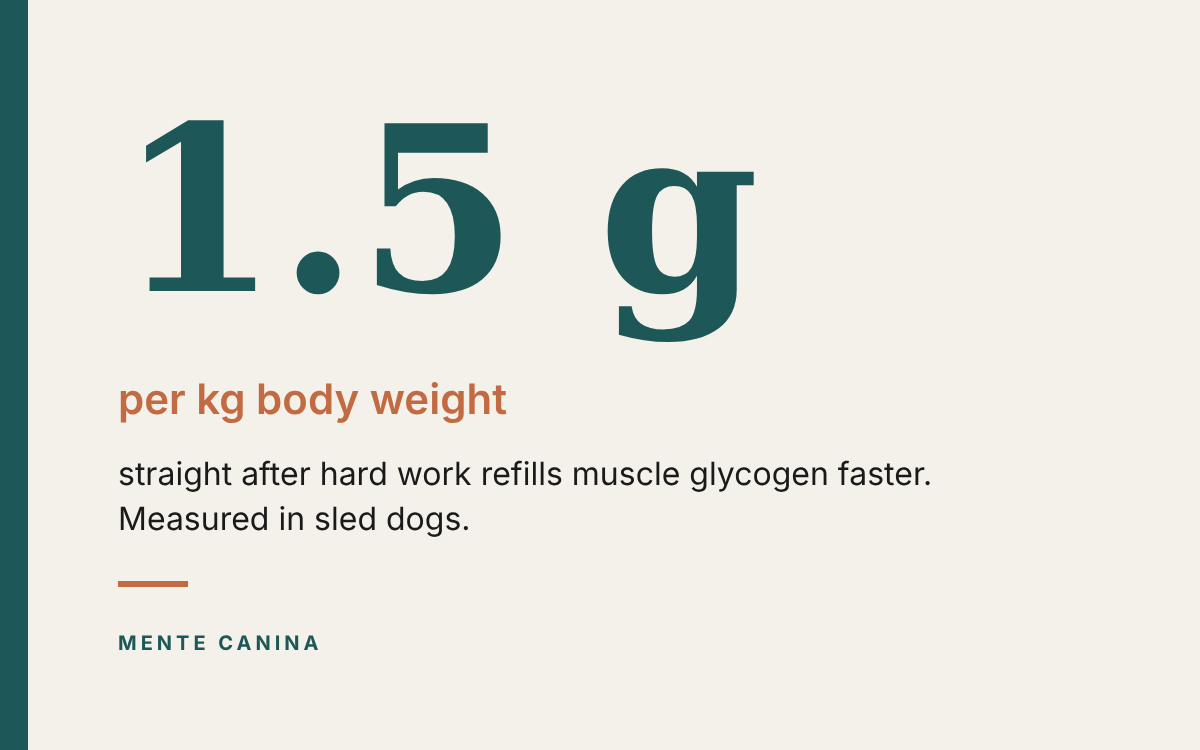
In 1997 Reynolds and colleagues had trained huskies run 30 kilometres. Some of them received 1.5 g of carbohydrate per kg body weight in water straight afterwards. After four hours these dogs had replaced about half of the muscle glycogen they had used; the others had replaced none yet. In a technical paper, Joseph Wakshlag of Cornell University therefore recommends this amount within 30 minutes for dogs that run between five minutes and three hours a day, especially if they have to perform again the next day. What the study measured was glycogen, not performance.
Converted to body weight, this is the amount from the study:
| Body weight | Carbohydrate | Maltodextrin in water | or rice, cooked |
|---|---|---|---|
| 20 kg | 30 g | about 32 g | about 105 g |
| 25 kg | 38 g | about 40 g | about 135 g |
| 30 kg | 45 g | about 47 g | about 160 g |
| 35 kg | 53 g | about 55 g | about 185 g |
| 40 kg | 60 g | about 63 g | about 215 g |
Calculated with 1.5 g carbohydrate per kg body weight, maltodextrin at about 95 % carbohydrate, cooked white rice at about 28 g per 100 g. For healthy adult dogs. This is the amount from a study in sled dogs after a 30 km run, not a tested recommendation for protection dogs. In normal training I give less myself. After an ordinary walk it is not needed.
What is still open
I did not find a feeding study on protection dogs. Not one. In 17 weight-pulling dogs, a carbohydrate bar between two pull series had no proven effect on performance. Blood lactate hardly rose, so the pulling was not very anaerobic.
Protection work is different. In 2026 an Italian study measured seven German Shepherds during the protection phase of an IGP1: lactate rose from 2.2 to about 9 mmol/l. That points to clearly anaerobic work in which the muscle uses glycogen. How much, lactate does not show, and no foods were compared.
I found no measurement of how much glycogen is missing after a day of protection training. And in racing Greyhounds, in the two existing trials the protein always changed along with the carbohydrate. They do not show what carbohydrate does on its own.
The most recent feeding study with working dogs that I found comes from New Zealand (2021). 22 herding dogs were randomly given either a typical food or one with almost no carbohydrate. The dogs without carbohydrate were more active, but their blood glucose dropped low more often, mostly at night. Working performance was not measured.
What I take from it
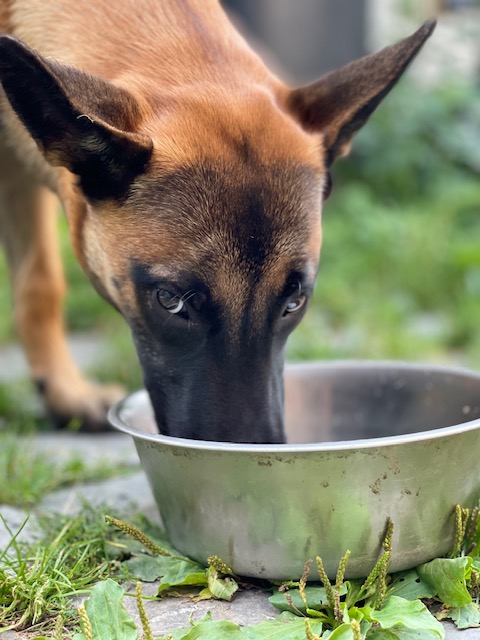
Today I feed a complete food containing carbohydrate as the base and add some raw food. After hard work my dogs also get rice or maltodextrin. What is proven is that this refills glycogen faster in sled dogs. That it also helps my Malinois after protection work is my conclusion, not proof. This works with any diet, including pure raw feeding.
Sources
- Kronfeld DS, Hammel EP, Ramberg CF, Dunlap HL (1977). Hematological and metabolic responses to training in racing sled dogs fed diets containing medium, low, or zero carbohydrate. American Journal of Clinical Nutrition, 30(3), 419-430.
- Reynolds AJ, Carey DP, Reinhart GA, et al. (1997). Effect of postexercise carbohydrate supplementation on muscle glycogen repletion in trained sled dogs. American Journal of Veterinary Research, 58(11), 1252-1256.
- Wakshlag JJ. The new age of working dogs. Undated technical paper, filed as a PDF at petfoodindustry.com in 2015 (recommendation 1.5 g maltodextrin per kg within 30 minutes).
- Frye CW, VanDeventer GM, Dinallo GK, et al. (2017). The effects of a post-exercise carbohydrate and protein supplement on repeat performance, serum chemistry, insulin and glucagon in competitive weight-pulling dogs. Journal of Nutritional Science, 6. doi:10.1017/jns.2017.23. Funded by Nestlé Purina.
- Cocco R, Sechi S, Rizzo M, et al. (2026). Metabolic and Physiological Responses of Trained Working Dogs During the Protection Phase of the IGP1. Veterinary Sciences, 13(4), 355.
- Hill RC, Bloomberg MS, Legrand-Defretin V, et al. (2000). Maintenance energy requirements and the effect of diet on performance of racing Greyhounds. American Journal of Veterinary Research, 61(12), 1566-1573.
- Hill RC, Lewis DD, Scott KC, et al. (2001). Effect of increased dietary protein and decreased dietary carbohydrate on performance and body composition in racing Greyhounds. American Journal of Veterinary Research, 62(3), 440-447.
- Gal A, Cuttance W, Cave N, et al. (2021). Less is more? Ultra-low carbohydrate diet and working dogs’ performance. PLoS ONE, 16(12), e0261506.
This text reflects the state of the studies cited and does not replace veterinary nutrition advice. I read the studies in the original or in the official abstract and searched for newer work in October 2026. Do you know one that is missing? Write to me. As of October 2026.