How I feed my dogs: what research really knows
I did not find a single feeding study on protection dogs. Not one. On the question of how hard protection work actually is on the dog, I found a single small study with seven German Shepherds. What dog sport says about carbohydrate, glycogen and sport foods comes almost entirely from sled dogs, Greyhounds and seventeen weight-pulling dogs.
I have more than 40 years of experience with working dogs. This article started with a simple question: Is raw food alone enough for a Malinois that trains hard in protection work? To answer it, I went through the studies that the feeding guides rely on myself. What came out of it is less comfortable than what most feeding guides say:
- In 1977 Kronfeld fed racing sled dogs a diet with no carbohydrate at all for 28 weeks. In his measurements he found no disadvantages.
- For real sprinters, racing Greyhounds, there are two small trials. In neither did only the carbohydrate change; the protein always changed too. They do not show what carbohydrate does on its own.
- In weight-pulling dogs a carbohydrate bar had no proven effect. The study was paid for by Nestlé Purina.
- During the protection phase of an IGP1 trial, blood lactate rose to 7 to 9 mmol/l. That points to clearly anaerobic work in which the muscle uses glycogen. How much, lactate does not show.
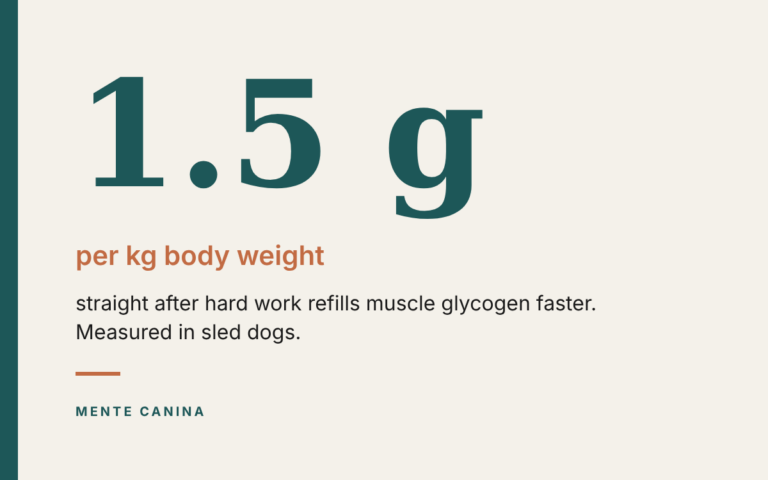
- Only one thing is really established, and that in sled dogs: carbohydrate straight after hard work refills muscle glycogen faster.
That is what I built my feeding on. What follows is not a rule for every dog but my own practice. Each statement says what it is based on.
Even if you do not have a sporting dog, you will find plenty here: how to read and check a food label, what to keep in mind with raw food and what research actually knows. Carbohydrate straight after work, on the other hand, only concerns dogs that work intensively. After a normal walk it is not needed.
I feed a dry food for sporting dogs as the base and add a ready-made raw food. I deliberately do not name the brands. What matters is the nutrient profile, not the name. I have no business relationship with any pet food manufacturer, and nobody pays me for this article. One of the studies below was funded by Purina, and I say so wherever it comes up. With Paco I have recently been trying a different dry food, and instead of raw food I add a steamed wet food. His stools are firmer, and perhaps I am imagining that he has a little more energy. But careful: more fibre binds the stool, and a few weeks prove nothing. The young dogs stay on their usual food for now. The figures in this article apply to the foods I calculated with in October 2026.
The nutrient values come from the manufacturers’ labels. The carbohydrate content of the dry food is not on the bag; I calculated it from the other values.
Established or not: the overview first
| Statement | Status | Source |
|---|---|---|
| Carbohydrate straight after hard work refills glycogen faster | established, measured in sled dogs after 30 km | Reynolds et al. 1997 |
| This carbohydrate improves performance on the same day | not proven | Frye et al. 2017 |
| A diet without carbohydrate causes disadvantages | not found in sled dogs over 28 weeks; in herding dogs more frequent low blood glucose, significance unclear | Kronfeld et al. 1977, Gal et al. 2021 |
| More carbohydrate makes sprinters faster | not resolved: in two small Greyhound trials the protein always changed too, and once the fat as well | Hill et al. 2000 and 2001 |
| Sprinters should get 40-50 % carbohydrate on a dry matter basis | expert recommendation, not a feeding trial | Cornell / Wakshlag |
| Protection work puts a clearly anaerobic load on the muscle | measured, but only in 7 dogs: lactate 7-9 mmol/l after the IGP1 protection phase | Cocco et al. 2026 |
| Protection dogs belong with the sprinters | my classification, only partly supported | Cocco et al. 2026 |
| Protection dogs need as much carbohydrate as agility dogs | open | no study found |
| Mushers feed a mix of dry food and meat | observed, 3 teams | Loftus et al. 2014 |
| Raw food sold in Switzerland often contains resistant bacteria | measured, 51 samples | Nüesch-Inderbinen et al. 2019 |
Chapter 1: What the studies really show
1.1 Kronfeld: zero carbohydrate, no disadvantage measured
This study rarely appears in feeding guides. Kronfeld and colleagues trained 18 racing sled dogs for 28 weeks on three diets: one supplied 38 % of energy from carbohydrate, one 23 % and one none at all. In the values measured, the dogs without carbohydrate showed no disadvantages. Their red blood cell values actually rose the most during training. The dog makes the glucose it needs itself (gluconeogenesis).
What the study does not say matters just as much. Blood values were measured; the abstract mentions no performance measurement. It says nothing about sprinters, and nothing about any particular raw food of today. It only shows that sled dogs could train hard without carbohydrate in their food without their blood values getting worse. Conversely, Kronfeld had already described in 1973 that sled dogs getting more than about 30 to 40 % of their energy from carbohydrate could show muscle stiffness and low blood sugar under hard work.
1.2 Reynolds: the one solid finding
Reynolds and colleagues had 24 trained huskies run 30 kilometres. Some of them received 1.5 g of glucose polymer per kg body weight in water straight afterwards. After four hours these dogs had replaced 49 % of the muscle glycogen they had used. In the dogs without it, nothing had been refilled yet in that time. In a technical paper Wakshlag therefore recommends maltodextrin, 1.5 g per kg within 30 minutes, for dogs that run between five minutes and three hours a day, especially if they have to perform again the next day. What was measured was muscle glycogen, not performance. Whether the dog becomes faster or stronger as a result, this study does not say.
1.3 Hill: two trials in real sprinters
Hill and colleagues fed eight racing Greyhounds two different diets. One supplied 43 % of energy from carbohydrate and 24 % from protein, the other 30 % from carbohydrate and 37 % from protein. Fat was 33 % in both. On the second diet the dogs were on average 0.18 seconds slower over 500 metres. The authors convert that into 2.6 metres. In a Greyhound race that is decisive.
A year earlier the same group had given seven racing Greyhounds a diet with more fat and protein and less carbohydrate. On it the dogs ran faster, 32.81 instead of 33.05 seconds. At first glance this is a contradiction.
The catch: in neither trial did only one nutrient change. In 2001 protein rose as carbohydrate fell. In 2000 fat changed as well. Which of these made the difference cannot be separated. Back in 1998 Hill had summarised from earlier trials that Greyhounds run faster with somewhat more fat and slower with more protein. Read that way, the two trials fit together: 2000 more fat, faster; 2001 more protein, slower. About carbohydrate alone they say little. And a Greyhound runs flat out for half a minute. Protection work looks different.
1.4 Frye: strength work in weight-pulling dogs
17 competitive weight-pulling dogs pulled twice, three hours apart. Nine received a bar with fast-digesting carbohydrate and protein after the first series, about 3.3 g per kg body weight; eight did not. With the bar, 8 of 9 pulled the same or more in the second series; without it, 4 of 8. That looks like a lot. With so few dogs, however, it is not statistically significant (p = 0.13). The authors interpret it as no effect and consider it possible themselves that there were too few dogs. The study was funded by Nestlé Purina. One co-author works there, and the bar was a Purina product.
More important for our question is another figure. Blood lactate rose after pulling only from 1.4 to 2.1 mmol/l, measured within one minute after the pull series. The authors conclude that weight pulling is hardly anaerobic. Racing Greyhounds reach about 30 mmol/l after a race. Short and explosive therefore does not automatically mean that the muscle empties its glycogen. In protection work, however, the picture is different.
1.5 Cocco: measurements during protection work
In April 2026 a study was published that measures protection work itself (Cocco et al. 2026). It is the only one of its kind I found. Italian researchers in Sardinia accompanied seven trained German Shepherds through the protection phase of an IGP1: search for the helper, hold and bark, prevention of an escape, defence against an attack and the attack out of motion. On average this took just under five minutes. Lactate, heart rate and muscle enzymes, among other things, were measured before the work and 3 and 10 minutes afterwards.
Lactate rose from 2.2 mmol/l at rest to 7.4 after 3 minutes and 9.1 after 10 minutes. That is more than four times as much as in the weight-pulling dogs, although the measurements were taken at different times. So the comparison is rough. It suggests that in protection work the muscle also works clearly without oxygen and uses sugar from its glycogen store to do so. How much glycogen cannot be read from lactate, however. The authors speak of a mixed load: rather aerobic during the search, anaerobic during the attack. They did not, however, measure this split separately.
The study has clear limits: only seven dogs, no control group, only part of the trial, and glycogen itself was not measured. The dogs were fed an energy-rich dry food; no foods were compared. So it is not a feeding study, and it says nothing about whether carbohydrate after protection work improves recovery or the next performance. But it shows with figures that protection work loads the muscle differently from weight pulling.
1.6 What mushers really feed
A team led by Wakshlag at Cornell University followed dog teams at the 1,600 km Yukon Quest 2011 (Loftus et al. 2014). The three teams that finished the race were analysed. All three fed commercial dry food plus meat: in their meals, in their drinking water and as raw snacks. No team fed raw meat only. On average 47 % of energy came from fat and 16 % from carbohydrate, the rest from protein. For the first half of the race the researchers calculated a requirement of 8,995 kcal per dog per day.
McKenzie and colleagues found something surprising in 48 sled dogs that ran 140 km a day for four days: after the first run, muscle glycogen had dropped markedly. After that it rose again from day to day, because the dogs used less of it with every run. They were fed a high-fat diet.
1.7 The most recent feeding study: almost no carbohydrate
The most recent feeding study with working dogs that I found comes from New Zealand (Gal et al. 2021). Researchers at Massey University randomly assigned 22 herding dogs on four farms to two groups. One received a typical food with 52 % of energy from carbohydrate, the other a food with only 1 %, and 63 % from fat instead. A sensor on the collar measured activity, and a glucose sensor on the skin measured tissue glucose every 15 minutes.
The dogs without carbohydrate were more active, even though their glucose was lower on average. Low readings were rare, just over 3 % of all measurements. But more than 90 % of them came from the dogs without carbohydrate, mostly at night while resting. What this means for the dog is unclear, because there are no reference values for this measurement in dogs yet.
The authors name the limitations themselves: the foods also differed in other nutrients, and because the dogs were fed in the evening, the night cannot be separated from digestion. In addition, activity was measured, not working performance. So the study does not say that dogs work better without carbohydrate. It confirms Kronfeld: it is possible without carbohydrate. And it shows that blood glucose then drops low more often.
1.8 All studies at a glance
| Study | Dogs | What was tested | Result |
|---|---|---|---|
| Kronfeld et al. 1977 | 18 racing sled dogs, 28 weeks | diets with 0 %, 23 % and 38 % of energy from carbohydrate | no adverse effects without carbohydrate |
| Reynolds et al. 1997 | 24 trained huskies, after 30 km | 1.5 g glucose polymer per kg body weight straight after the run | 49 % of the glycogen used replaced after 4 hours, nothing yet without it |
| Hill et al. 2000 | 7 racing Greyhounds | more fat and protein, less carbohydrate versus less fat and protein | faster with more fat and protein: 32.81 instead of 33.05 s over 500 m |
| Hill et al. 2001 | 8 racing Greyhounds | 43 % versus 30 % of energy from carbohydrate (protein 24 % versus 37 %) | 0.18 s slower over 500 m with more protein and less carbohydrate |
| Loftus et al. 2014 | 3 teams at the Yukon Quest 2011 | what mushers actually feed during the race | dry food plus meat, 47 % of energy from fat, 16 % from carbohydrate |
| Frye et al. 2017 | 17 weight-pulling dogs | bar with carbohydrate and protein between two pull series | 8 of 9 versus 4 of 8 pulled the same or more, not statistically significant |
| Cocco et al. 2026 | 7 German Shepherds, IGP1 | lactate, heart rate and muscle values during protection work, no food comparison | lactate from 2.2 to 7.4 (after 3 min) and 9.1 mmol/l (after 10 min) |
| McKenzie et al. 2008 | 48 sled dogs, 4 days of 140 km each | muscle glycogen over several days, high-fat diet | rose from day to day because less was used |
| Gal et al. 2021 | 22 herding dogs on farms in New Zealand | 1 % versus 52 % of energy from carbohydrate | without carbohydrate more activity, but more frequent low blood glucose, mainly at night; performance not measured |
Chapter 2: How the dog gets its energy
2.1 Three systems that run at the same time
The dog gets its energy from three systems. They do not run one after another like three gears but always at the same time. Depending on the load, one or the other contributes more. The times in the table only show when a system supplies the main share.
| System | Main share (approximate) | Fuel | In dog sport |
|---|---|---|---|
| ATP-creatine phosphate system | first seconds | stored ATP and creatine phosphate | attack, first sprint, jump |
| Glycolytic system | up to about 2 minutes | glucose and glycogen (anaerobic) | protection work exercises, short sprints |
| Oxidative system | from about 2 minutes | fat, carbohydrate, a little protein (aerobic) | endurance, tracking, police work |
The energy sources in dogs are described, for example, by the veterinary nutritionist Justin Shmalberg (2014). The division into three systems and the time limits are guide values from general sports physiology, not from dog studies. For racing Greyhounds, Shmalberg writes that the first seconds are almost entirely anaerobic and that half of the energy is already obtained aerobically in the first minute of the race.
2.2 Fat is the main fuel, but the dog can handle starch too
During long work, a dog obtains up to 70 % of its energy from fat, according to Wakshlag. At the same time it is no wolf: dogs carry more copies of the amylase gene AMY2B than wolves and digest starch well (Axelsson et al. 2013, “Nature”). So the dog does not strictly need carbohydrate in its food, but it can use it.
Chapter 3: Where does the protection dog belong?
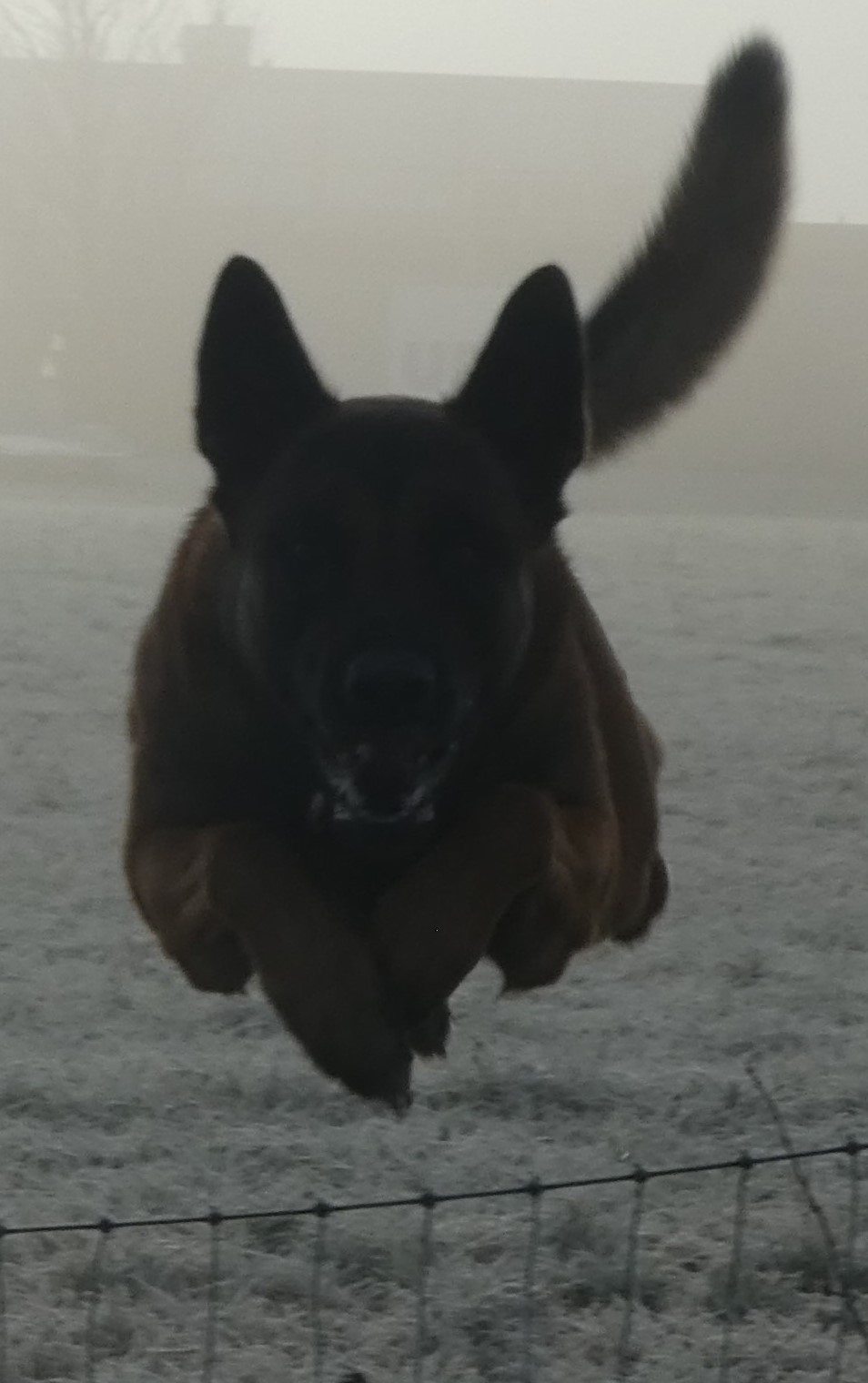
3.1 The Cornell classification
The Riney Canine Health Center at Cornell University divides sporting dogs into three groups, with statements from Prof. Joseph Wakshlag:
| Type | Examples at Cornell | Diet profile according to Cornell |
|---|---|---|
| Endurance | sled dogs | up to 35 % fat on a dry matter basis, 500-600 kcal per cup |
| Medium activity | hunting dogs, open-field herding dogs, search and rescue dogs | more fat and energy when building up to competitions, no percentages |
| Sprinters | agility, dock diving, flyball, lure coursing | 40-50 % carbohydrate and 12-17 % fat on a dry matter basis, 300-400 kcal per cup, carbohydrate after exercise |
A “cup” is an American volume measure, about 240 ml of dry food. The figure mainly shows that endurance diets are far more energy-dense than sprinter diets.
For sprinters, Wakshlag proposes about 30 % of energy from fat and 24 % from protein, the rest from carbohydrate. He notes himself that this roughly matches the profile of many ordinary adult dog foods. So no special food is needed for it.
3.2 My classification, and where it wobbles
Cornell does not mention Schutzhund or ring sports. Because of the short, explosive efforts I counted them among the sprinters for a long time. The lactate values from the weight-pulling study made me doubt that. The measurement during protection work points back towards it: 7 to 9 mmol/l indicate clearly anaerobic work. Even so, the protection dog does not fit the sprinters entirely. Protection work is intermittent: a few seconds of full power, then a pause, obedience, waiting. I found no measurement of how much glycogen a Malinois uses on a training day. I assume it is usually less than for an agility dog with several runs on a competition day. I cannot prove it.
Chapter 4: What I feed
4.1 Checking food labels: dry matter and energy
Nutrient percentages refer either to the share of dry matter (DM), the share of the food as it is in the bag, or the share of metabolisable energy (ME). Fat supplies about 8.5 kcal per gram, protein and carbohydrate about 3.5 kcal each (modified Atwater factors according to NRC 2006). That is why fat weighs more in the energy share. This is how I calculate it for my dry food:
| Nutrient | per 100 g of food | kcal | Share of energy |
|---|---|---|---|
| Protein | 31 g | 108 | 28 % |
| Fat | 21 g | 179 | 45 % |
| Carbohydrate (calculated) | about 30 g | 107 | 27 % |
| Total | 394 | 100 % |
Protein and fat are manufacturer’s values. Carbohydrate is not on the bag. I calculated it as 100 g minus protein, fat, crude fibre (2 g), crude ash (7.5 g) and moisture, which I assumed to be 8 g. The manufacturer states 410 kcal per 100 g; my calculation gives 394. The difference comes from different calculation factors and changes the shares very little.
For raw food, which is very highly digestible, the usual factors are 4 kcal per gram of protein and carbohydrate and 9 kcal per gram of fat. For my raw food that gives 15 × 4 + 18 × 9 = 222 kcal per 100 g, exactly the 2,220 kcal per kg stated by the manufacturer. With the free Mente Canina food calculator you can check this for your own food. For raw food it calculates the same way, for dry food with the more accurate equations recommended by FEDIAF.
4.2 The foods compared
| Product | Protein | Fat | Carbohydrate | Carbohydrate share of energy | Matches the sprinter profile? |
|---|---|---|---|---|---|
| My raw food (ready-made raw) | 15 % | 18 % | 0 % | 0 % | no, no carbohydrate |
| My dry food (sporting dog) | 31 % | 21 % | about 30 % (calculated) | 27 % | no, more protein and fat |
| Sprinter profile according to Wakshlag (dry matter) | 24-28 % | 12-14 % | 45-50 % | about 46 % | reference |
The foods are shown here as they are in the bag or pack. Wakshlag’s values refer to dry matter. Converted to dry matter, my dry food has about 34 % protein, 23 % fat and 33 % carbohydrate. According to the manufacturer, 73 % of the energy in the raw food comes from fat.
My dry food is rich in protein and fat. Measured against Wakshlag’s proposal for sprinters, it is closer to an endurance food. I use it as the base because it is a complete food and supplies a working dog with enough protein and fat.
4.3 My mix, recalculated, and why I changed it
Until recently I fed it the other way round: about 70 % raw food and 30 % dry food by weight. For this article I calculated it precisely for the first time:
| Component | Protein | Fat | Carbohydrate | kcal |
|---|---|---|---|---|
| 70 g raw food | 10.5 g | 12.6 g | 0 g | 155 |
| 30 g dry food | 9.3 g | 6.3 g | 9.2 g | 123 |
| 100 g of the mix | 19.8 g | 18.9 g | 9.2 g | 278 |
| Share of energy | 27 % | 61 % | 12 % |
Energy according to the manufacturers (raw food 2,220 kcal per kg, dry food 4,100 kcal per kg). Shares for the raw food according to the manufacturer (73 % from fat, 27 % from protein), for the dry food according to my calculation in 4.1.
Only 12 % of the energy came from carbohydrate, less than in the Yukon Quest teams with 16 %. I had been convinced that I was giving my dogs enough. The figures showed something else.
Today the dry food is the base and the raw food is added, about 150 g a day. For my 33 kg Malinois a day looks like this:
| Component | Amount per day | kcal | Carbohydrate |
|---|---|---|---|
| Dry food | 350 g | 1,435 | 107 g |
| Raw food | about 150 g | 333 | 0 g |
| Total | about 1,770 | 22 % of energy |
So about 22 % of the energy comes from carbohydrate. On days with 50-80 g of rice after training it is about 24-25 %, with the study amount of about 175 g of rice about 28 %. That stays just below the threshold of 30 to 40 % above which Kronfeld saw problems in sled dogs, and well below what Cornell gives for sprinters. More carbohydrate in the food is not proven for protection work. What is proven in sled dogs is its benefit for glycogen straight after hard work, and that is where I use it deliberately.
4.4 Why I still add raw food
Not because it is necessary. My dry food is a complete food, and I found no evidence that fresh meat in the bowl makes a healthy sporting dog better. I add raw food because after more than 40 years I do not want to feed only dry food from the bag. That is my reason, not a scientific one. Both foods are declared complete by their manufacturers. If each meets the minimum values per calorie on its own, mathematically the mix does too. I have not checked this nutrient by nutrient. The only important thing is that the raw food replaces calories and is not added on top. The mushers at the Yukon Quest do essentially the same: dry food as the base, meat on top.
Anny Malo and Marco Rivest feed their sled dogs in a similar way: a high-quality dry food as the base, lean beef added and a carbohydrate supplement within 30 minutes of training. More on this in the interview with them in this issue.
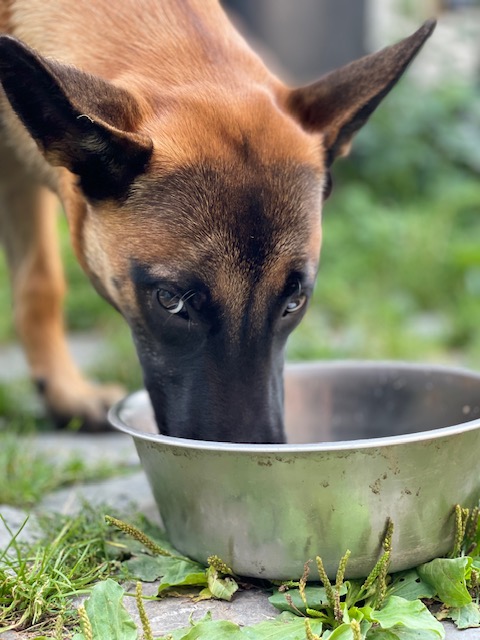
Chapter 5: My daily plan
What follows is my practice. Where there is a study on it, I name it.
5.1 My Malinois, 33 kg
| When | What | Amount | Why |
|---|---|---|---|
| After a hard session, within 30 minutes | Cooked white rice or maltodextrin in water | 50-80 g rice (see note) | refill glycogen |
| After training | My dry food (sporting dog) | 175 g | basic nutrition |
| After training | Raw food | about 75 g | variety |
| Evening | My dry food (sporting dog) | 175 g | basic nutrition |
| Evening | Raw food | about 75 g | variety |
| Now and then, with one meal | Salmon oil | up to 10 ml | omega-3 fatty acids |
| 1-2 times a week | Raw food with salmon instead of the usual variety | same amount | variety, omega-3 |
Together that comes to about 1,770 kcal a day, a little more with salmon oil. The European FEDIAF guidelines calculate 125 kcal per kg body weight to the power of 0.75 for a dog with one to three hours of intensive activity a day, which is about 1,720 kcal for 33 kg. My amount is close to that figure. On rest days the two meals are given in the morning and in the evening. What counts, however, is the dog, not the number: if it gains or loses weight, I adjust the amount.
The study dose by body weight:
| Body weight | Carbohydrate | Maltodextrin in water | or rice, cooked |
|---|---|---|---|
| 20 kg | 30 g | about 32 g | about 105 g |
| 25 kg | 38 g | about 40 g | about 135 g |
| 30 kg | 45 g | about 47 g | about 160 g |
| 35 kg | 53 g | about 55 g | about 185 g |
| 40 kg | 60 g | about 63 g | about 215 g |
Calculated with 1.5 g carbohydrate per kg body weight (Reynolds et al. 1997, Wakshlag), maltodextrin at about 95 % carbohydrate, cooked white rice at about 28 g per 100 g (USDA). For healthy adult dogs. This is the amount from a study in sled dogs after a 30 km run, converted to body weight. It is not a tested recommendation for protection dogs.
5.2 Trial day
- On the morning of a trial: a small meal 2-3 hours beforehand, low in fat.
- Between exercises: small carbohydrate snacks.
- After the trial: carbohydrate at the study dose (see note above), then a normal meal.
What I do not do: “load” carbohydrate the evening before. 30 g more dry food is about 9 g of carbohydrate; that achieves nothing. I know of no study showing that carbohydrate loading works in dogs.
5.3 Rest periods
During breaks in training I reduce the total amount so that the dog does not gain weight. The scales show how much.
Chapter 6: Raw food and hygiene
Anyone who feeds raw needs to know this. Researchers at the University of Zurich tested 51 raw food samples from Swiss suppliers. About 73 % exceeded the guide value for Enterobacteriaceae. About 61 % contained ESBL-producing bacteria, which are resistant to many antibiotics. They found Salmonella in two samples, and in two samples E. coli carrying the mcr-1 gene, which protects against the last-resort antibiotic colistin (Nüesch-Inderbinen et al. 2019).
That does not mean that every raw-fed dog falls ill. It means that dogs and people can pass these bacteria on. This is how I handle it:
- Store raw food frozen and thaw it in the fridge.
- Separate bowls, boards and knives used only for dog food.
- Wash the bowl in hot water after every meal, then wash your hands.
- Small children, pregnant women and people with weakened immune systems do not come into contact with the raw food.
Chapter 7: My answer to the opening question
Is raw food alone enough for a Malinois that trains hard in protection work? For basic nutrition, very probably yes. Kronfeld’s sled dogs worked for 28 weeks without carbohydrate, the herding dogs in New Zealand were even more active on almost zero carbohydrate, and the dog rebuilds its glycogen even without carbohydrate in its food. But more slowly: with carbohydrate straight after work, about half of the glycogen used had been replaced after four hours; without it, none yet. Anyone who asks their dog to perform again on the same or the next day therefore has a good reason to give carbohydrate after work, whatever else they feed. That the dog works better as a result, however, the study does not show. I myself now feed a complete food containing carbohydrate as the base and give rice or maltodextrin in addition after hard work.
What I do not know: how much protection work really empties the stores. The measurement during protection work shows a lot of lactate. That suggests the muscle draws heavily on its glycogen. I found no measurement in protection dogs of how much of it is missing after a training day. That carbohydrate after protection work helps is something I infer from this measurement and from the sled dog study. For the protection dog it is not proven.
Chapter 8: At a glance
My Malinois, 33 kg
| What | Amount | When |
|---|---|---|
| My dry food (sporting dog) | 350 g per day | split over 2 meals |
| Raw food | about 150 g per day | split over 2 meals |
| Salmon oil | up to 10 ml | now and then with one meal |
| Cooked rice or maltodextrin | 50-80 g rice in training, on trial days about 175 g rice or just over 50 g maltodextrin | after hard work, within 30 minutes |
| Raw food with salmon | same amount as Original | 1-2 times a week |
References
- Axelsson E, et al. (2013). The genomic signature of dog domestication reveals adaptation to a starch-rich diet. Nature, 495, 360-364.
- Cocco R, Sechi S, Rizzo M, Giannetto C, Arrigo F, Pinna Parpaglia ML, Piccione G, Arfuso F (2026). Metabolic and Physiological Responses of Trained Working Dogs During the Protection Phase of the «Internationale Gebrauchshunde Prüfungs-Ordnung, Level 1» (IGP1). Veterinary Sciences, 13(4), 355. doi:10.3390/vetsci13040355
- Cornell University, Riney Canine Health Center. Feeding your performance dog (with statements by J. J. Wakshlag). Page at vet.cornell.edu
- FEDIAF (2025). Nutritional Guidelines for Complete and Complementary Pet Food for Cats and Dogs. Publication September 2025. Brussels: The European Pet Food Industry Federation.
- Frye CW, VanDeventer GM, Dinallo GK, Poplarski JA, Mann S, Pittman E, Zanghi BM, Wakshlag JJ (2017). The effects of a post-exercise carbohydrate and protein supplement on repeat performance, serum chemistry, insulin and glucagon in competitive weight-pulling dogs. Journal of Nutritional Science, 6. doi:10.1017/jns.2017.23. Funded by Nestlé Purina PetCare.
- Gal A, Cuttance W, Cave N, Lopez-Villalobos N, Herndon A, Giles J, Burchell R (2021). Less is more? Ultra-low carbohydrate diet and working dogs’ performance. PLoS ONE, 16(12), e0261506. doi:10.1371/journal.pone.0261506
- Hill RC (1998). The nutritional requirements of exercising dogs. Journal of Nutrition, 128(12 Suppl), 2686S-2690S.
- Hill RC, Bloomberg MS, Legrand-Defretin V, et al. (2000). Maintenance energy requirements and the effect of diet on performance of racing Greyhounds. American Journal of Veterinary Research, 61(12), 1566-1573.
- Hill RC, Lewis DD, Scott KC, et al. (2001). Effect of increased dietary protein and decreased dietary carbohydrate on performance and body composition in racing Greyhounds. American Journal of Veterinary Research, 62(3), 440-447.
- Kronfeld DS (1973). Diet and the performance of racing sled dogs. Journal of the American Veterinary Medical Association, 162, 470-473. Cited from Loftus et al. 2014.
- Kronfeld DS, Hammel EP, Ramberg CF, Dunlap HL (1977). Hematological and metabolic responses to training in racing sled dogs fed diets containing medium, low, or zero carbohydrate. American Journal of Clinical Nutrition, 30(3), 419-430.
- Loftus JP, Yazwinski M, Milizio JG, Wakshlag JJ (2014). Energy requirements for racing endurance sled dogs. Journal of Nutritional Science, 3, e34. doi:10.1017/jns.2014.31
- McKenzie EC, Hinchcliff KW, Valberg SJ, Williamson KK, Payton ME, Davis MS (2008). Assessment of alterations in triglyceride and glycogen concentrations in muscle tissue of Alaskan sled dogs during repetitive prolonged exercise. American Journal of Veterinary Research, 69(8), 1097-1103.
- National Research Council (2006). Nutrient Requirements of Dogs and Cats. National Academies Press, Washington DC.
- Nüesch-Inderbinen M, Treier A, Zurfluh K, Stephan R (2019). Raw meat-based diets for companion animals: a potential source of transmission of pathogenic and antimicrobial-resistant Enterobacteriaceae. Royal Society Open Science, 6, 191170.
- Reynolds AJ, Carey DP, Reinhart GA, et al. (1997). Effect of postexercise carbohydrate supplementation on muscle glycogen repletion in trained sled dogs. American Journal of Veterinary Research, 58(11), 1252-1256.
- Shmalberg J (2014). Canine performance nutrition. Today’s Veterinary Practice, November/December 2014. Article online
- U.S. Department of Agriculture. FoodData Central, entry 168878: Rice, white, long-grain, regular, enriched, cooked.
- Wakshlag JJ. The new age of working dogs. Undated technical paper, filed as a PDF at petfoodindustry.com in 2015. The recommendation “1.5 g maltodextrin per kg within 30 minutes” appears there with reference to Reynolds et al. 1997 and Wakshlag et al. 2002. PDF at petfoodindustry.com
- Nutrient values of the foods: manufacturers’ information on the packaging of my two foods (as of October 2026).
This article describes how I feed my dogs, based on more than 40 years of experience and on the research cited. It does not replace veterinary nutrition advice. Every dog is different. If in doubt, discuss amounts and composition with a specialist. Different rules apply to puppies and breeding bitches; a separate article on them will follow.
For questions about rations: nutrition advice service of the Institute of Animal Nutrition and Dietetics, Vetsuisse Faculty, University of Zurich (fee-based).
How I researched this: I read the studies cited in the original and searched for newer work in October 2026. A search of this kind can miss a study. Do you know one that is missing here, or have you found an error? Write to me. I will check it, correct the text and note the correction here. You will find the address in the legal notice.
As of October 2026.